Which pack is cheaper? Unit price vs checkout total
The pack with the lowest price per kilogram can still cost more at checkout. Three shelf decisions make the difference visible, with worked answers and a reusable calculation.
One shelf, three different questions
You reach for the bigger pack: more food for your money. Then you remember how much you can spend today. Which pack is cheaper?
That question can mean three things: the lowest price for an equal quantity, the lowest amount paid today, or the least expensive purchase that supplies what you need. They do not always point to the same pack.
Try these three fictional shelves before reading the answers. Within each case, the packs contain the same substitutable product. All prices are invented final amounts for the packs; there are no extra charges.
Put both packs on the same scale
A unit price expresses the price for a standard quantity, such as one kilogram. To compare packs measured in grams, calculate: price ÷ grams × 1,000 = price per kilogram.
Use the same unit for both packs. Keep the full calculation until the end, then round for display. Multiplying an already rounded price per 100 g can distort a close comparison.
Shelf 1: two sizes and a €4 limit
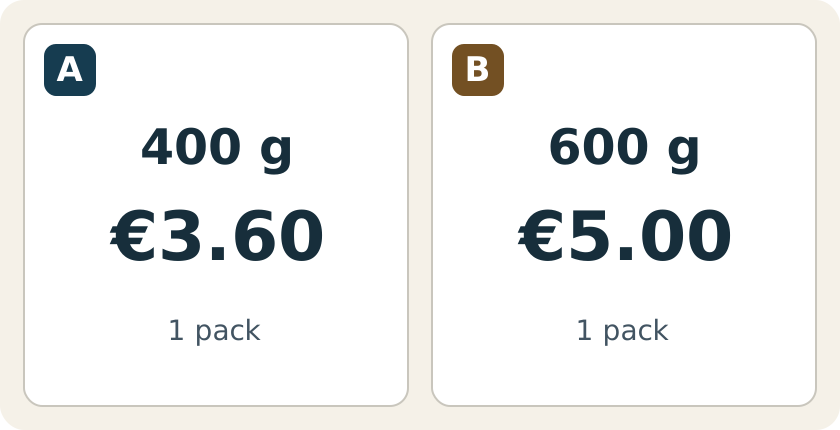
Pack A contains 400 g for €3.60. Pack B contains 600 g for €5.00.
Choose before continuing: which has the lower price per kilogram? Now choose again: you need at least 350 g, may buy one pack, and can spend at most €4. Which purchase works?
Answer 1
A: €3.60 ÷ 400 × 1,000 = €9 per kg. B: €5.00 ÷ 600 × 1,000 = €8.333… per kg, or about €8.33 per kg.
B has the lower unit price. A is the purchase that meets both stated constraints: 400 g is enough and €3.60 fits the €4 budget. B would require €1 more than you can spend.
If the budget or required quantity changes, reconsider the choice. A lower rate is useful information; it does not change the amount due at checkout.
Shelf 2: the offer requires two packs
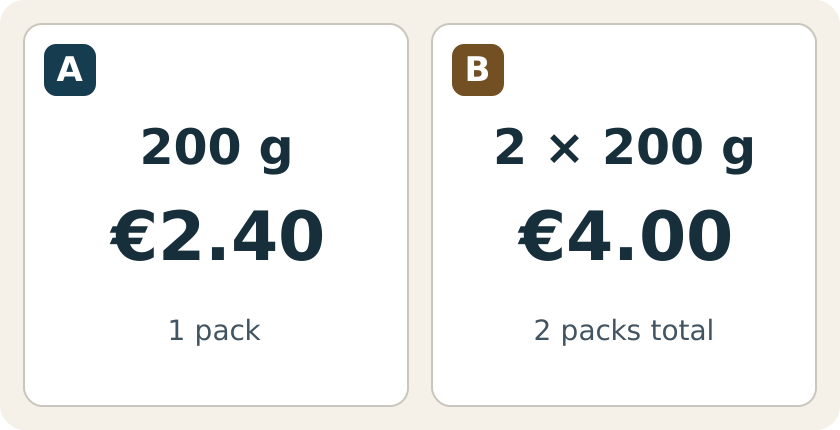
One 200 g pack costs €2.40. An offer gives you two of those packs for €4.00, but only if you buy both. One pack still costs €2.40.
Which option has the lower unit price? Which costs less today if you need only 200 g? Decide before the answer.
Answer 2
Single pack: €2.40 ÷ 200 × 1,000 = €12 per kg. Pair: €4.00 ÷ 400 × 1,000 = €10 per kg.
The pair has the lower unit price, but costs €1.60 more today than one pack. Its €0.80 saving is against buying two packs separately for €4.80, not against buying one.
If the extra 200 g will be useful and €4 fits your budget, the pair may suit you. If one pack meets your need, €2.40 is the smaller payment. Read the required quantity before treating an offer price as the price of a single pack.
Shelf 3: one pack for a 700 g need
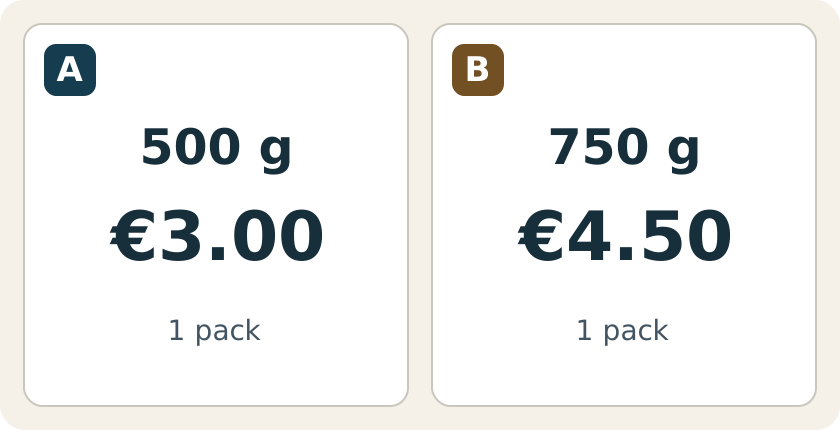
A 500 g pack costs €3.00; a 750 g pack costs €4.50. Does either have a lower unit price? If you need 700 g and will buy one pack, which is enough?
Answer 3
€3.00 ÷ 500 × 1,000 = €6 per kg. €4.50 ÷ 750 × 1,000 = €6 per kg too. The larger pack supplies more at exactly the same rate.
For the stated 700 g need, only the 750 g pack is enough. If you needed 400 g instead, either would supply enough and the smaller pack would cost less today.
At your next shelf
- Check that the products are suitable substitutes for your purpose.
- Compare the same unit, such as €/kg with €/kg.
- Read any quantity or eligibility condition on an offer.
- Check both the amount payable and the amount you can use.